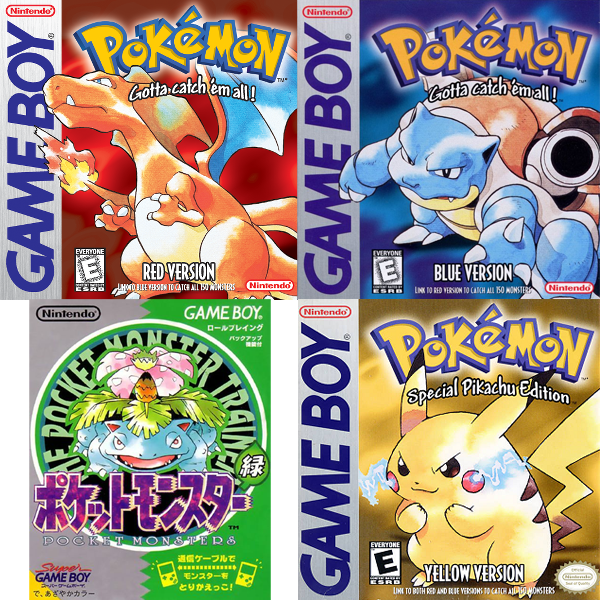
In 1996, as Nintendo was gearing up to promote their then upcoming foray into the world of 3D gameplay, a little company called Game Freak was coming in to develop a new RPG for Nintendo's then 7 year old gray brick called the GameBoy.
While the GameBoy was quite popular, it had definitely shown its age. Competitors like the Sega Game Gear and even Atari's Lynx beat it out in terms of graphical fidelity for a handheld console. Nevertheless, Game Freak would release
'Pocket Monsters' Red and Green on February 27, 1996 and become a sensation overnight. Game Freak wouldn't stop there, and announced a third version called 'Pocket Monsters Blue' later that year which would get a retail release on October 10, 1999 with earlier
mail delivery releases throughout 1997. Pocket Monsters Blue would later become the basis for the localized releases of Pocket Monsters outside Japan, including bug fixes and improved sprite art.
The Pocket Monster trilogy would go on to sell
10.23 million copies in Japan alone.
But of course, that begs the question. Could this go global?
Nintendo and Game Freak knew they had captured lightning in a bottle, and they were certain that a worldwide release of 'Pocket Monsters' (later shortened to just Pokémon) would be a hit. And so Nintendo went through a blitz of advertising. The popularity of Pokémon
in Japan began the production of an Anime spinoff, which Nintendo would choose to also air outside of Japan. Making it one of the first widespread Anime to get a massive following in the US, alongside shows like Dragon Ball Z and Sailor Moon. Nintendo would release
toys, comics, trading cards, and write articles to drum up excitement for the upcoming releases in Nintendo Power. Nintendo and Game Freak's efforts paid off, Pokémon Red and Blue would be smash hits and the series would sell tens of millions of copies.
Children around the globe had now contracted Pokémania. Pokémon would have one final release for the first generation of games, Pokémon Yellow. As a tie-in with the Anime it's loosely based on what were now staples of the show; like redesigns for Gym Leaders Brock, Misty, and
Professor Oak's Grandson (it's Gary, everyone knows that's Gary Oak), Team Rocket's Jessie and James following and battling the player, and of course leaving Pallet Town with a Pikachu as your starter. Pokémon Yellow alone would sell 14 million copies worldwide, as of 2014.
Nowadays it's hard to imagine a world without Pokémon. The series is still the largest grossing media franchise at over $115 billion dollars. The series has so many games, spinoffs, anime episodes and movies, cards, figures, plushes, anything and everything has probably
has Pikachu's cute little face slapped onto it. But if you were to go back to this series humble beginnings, would it hold up? While people criticize the modern games for playing things too safe and samey, how hard is it to go back to the beginning?
Well I had decided to get the original three GameBoy games: Red Blue and Yellow, and complete the games front to back and then some. Collecting literally every single Pokémon in what's called a 'Living Dex' challenge. While it was quite the challenge, I can safely say that
even today the first Generation of Pokémon holds up remarkably well for a GameBoy RPG.
A